Reduction Plans → Recommendations
The Reduction Recommendations module transforms raw emissions data into actionable, AI-driven decarbonization strategies, empowering organizations to identify and implement effective emission reduction measures across Scopes 1, 2, and 3.
Written By CarbonX Registry
Last updated 12 months ago
Built on CarbonX’s Agentic Intelligence Engine, this module uses advanced data analytics and contextual reasoning to pinpoint each organization’s most impactful reduction opportunities — customized to its operational footprint, geographic location, and industry-specific activity patterns.
Every recommendation is not just a generic sustainability tip, but a data-grounded strategy that includes clear implementation guidance, quantified impact estimates, and integration with organizational performance tracking.

Image: Reduction Recommendations interface displaying AI-generated strategies categorized by emission scope and type, with quantified savings, complexity scores, and actionable guidance.
1. Overview
The Reduction Recommendations page serves as the analytical centerpiece of CarbonX’s decarbonization toolkit.
It leverages machine learning to review all validated emissions data — from direct fuel use to supply chain activities — and automatically generate reduction strategies that are both feasible and measurable.
Core Focus Areas:
Prioritizing high-impact emission categories: The system identifies where reductions will produce the largest measurable benefit in CO₂e terms.
Suggesting actionable and regionally relevant measures: Recommendations consider local regulations, available technologies, and supply chain realities.
Quantifying potential savings: Each action includes an estimated annual CO₂e reduction value (tCO₂e/year), helping users prioritize actions based on impact and effort.
Recommendations are structured under Scope 1, Scope 2, and Scope 3 tabs, ensuring that users can distinguish between direct, indirect, and value chain emission reduction opportunities.
Example Outcomes:
Scope 1: “Switch from diesel generators to biogas-powered backup units” → 48 tCO₂e saved/year.
Scope 2: “Implement dynamic energy demand scheduling and PPA agreements” → 220 tCO₂e saved/year.
Scope 3: “Prioritize local suppliers within 250 km for purchased goods” → 185 tCO₂e saved/year.
2. Interface and Layout
The module interface is organized for clarity and contextual relevance, making it easy for users to navigate, review, and act upon AI-generated insights.
A. Tabs by Scope
At the top of the interface, three tabs represent the emission boundaries:
Scope 1: Direct operational emissions (e.g., stationary and mobile combustion, process emissions).
Scope 2: Indirect energy-related emissions (e.g., purchased electricity, heat, steam).
Scope 3: Value chain emissions (e.g., purchased goods, business travel, logistics, waste).
Each tab presents tailored AI suggestions based on the corresponding emission sources identified in the user’s dataset.
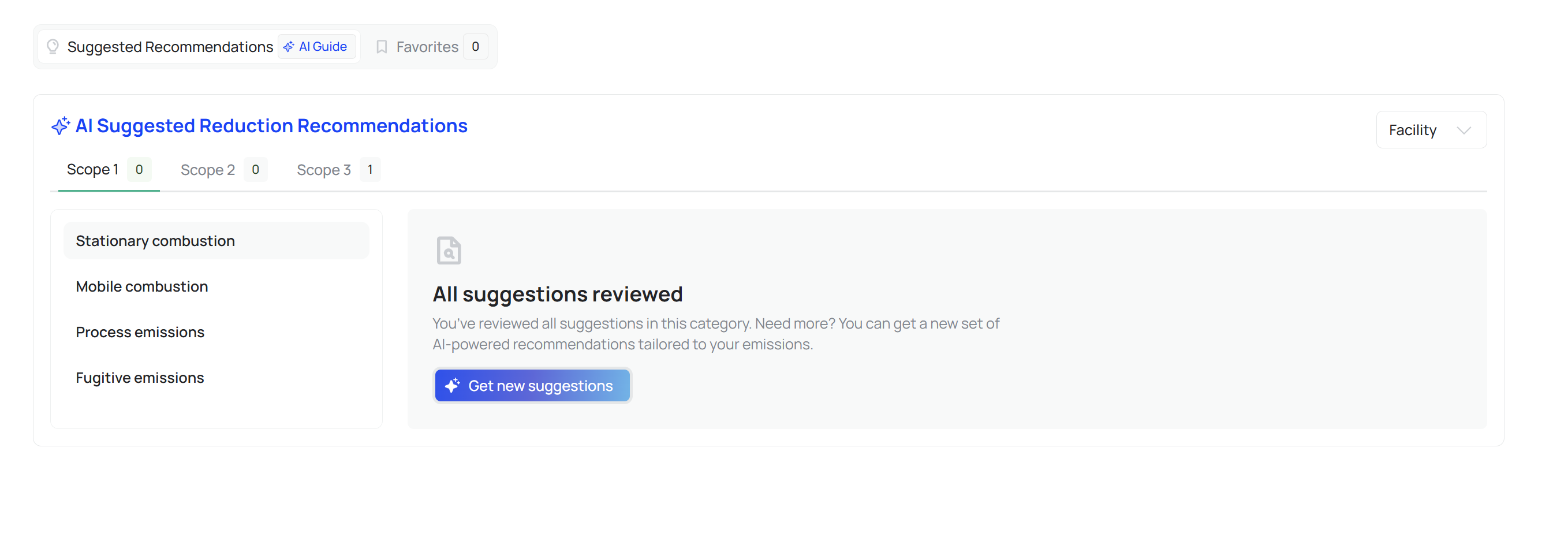
B. AI-Suggested Reduction Recommendations Panel
This dynamic panel displays a categorized breakdown of key emission areas relevant to the selected scope.
Common categories include:
Stationary Combustion
Mobile Combustion
Process Emissions
Fugitive Emissions
Purchased Goods & Services
Business Travel
Employee Commuting
Upstream/Downstream Transport and Distribution
End-of-Life Treatment
Each category contains a curated list of recommendation cards, generated by CarbonX’s AI engine based on the organization’s specific emissions profile.

C. Recommendation Cards
Each recommendation card provides a structured overview of an actionable measure, presented in a concise and easily comparable format.
Components:
Title: Clear action statement (e.g., “Optimize fleet routes using AI-based logistics planning”).
Estimated Emission Saving: Quantified potential reduction (e.g., 32 tCO₂e/year).
Type: Categorized as Operational, Strategic, or Procurement-Based, indicating the nature of intervention.
Difficulty Score: Indicates implementation complexity, ranging from Low (quick wins) to High (multi-phase projects).
Facility: Automatically linked to the relevant organization site for localized implementation tracking.
Why It Matters: Explains environmental and compliance relevance — e.g., “Reduces Scope 2 grid dependency and supports renewable energy transition under ISO 14064.”
How to Take Action: Provides step-by-step execution guidance, including possible partners, tools, or internal teams to engage.
Visual Indicators:
Icons for scope and category identification.
Color-coded bars for impact level (Low / Medium / High).
Quick buttons for saving, exporting, or integrating with reduction targets.
3. AI Guidance and User Feedback
The AI engine continuously refines its recommendations through user interactions and feedback loops, ensuring that the insights evolve with the organization’s progress.
A. Get New Suggestions
After reviewing all current recommendations, users can click “Get New Suggestions” to refresh the list.
The AI will analyze the latest emissions dataset — incorporating new data from uploads, integrations, or recalculations — and generate an updated set of prioritized actions.
B. Suggest Alternative Button
Users can click “Suggest Alternative” within any recommendation card to request more localized or sector-specific actions for the same emission category.
This feature is particularly valuable for multinational organizations or companies operating in diverse regulatory environments.
C. Feedback Controls
Each recommendation includes thumbs-up/down icons for user feedback.
These responses train the AI model to:
Recognize which recommendations are most relevant or effective.
Adapt future suggestions to align with the organization’s preferences, constraints, and progress history.
Over time, this creates a personalized decarbonization strategy engine uniquely attuned to the organization’s profile.
4. Impact Metrics
Every recommendation is backed by quantifiable and qualitative performance indicators, allowing users to assess priority and feasibility at a glance.
Included Metrics:
tCO₂e Reduction Estimate per Year: Projected annual emission reduction based on activity data, local energy mix, and baseline emissions.
Implementation Complexity: Estimated difficulty level derived from cost range, project duration, and potential operational disruption.
Impact Level (Low/Medium/High): Represents the expected contribution of the measure to achieving the company’s net-zero trajectory.
Estimated Payback Period (if available): Optional field estimating ROI or cost recovery horizon for investment-based actions.
Example:
“Install rooftop solar at Facility A — Est. 110 tCO₂e reduction/year, Medium complexity, High impact, ~3.2-year payback.”
5. Use Case
The Reduction Recommendations module provides a direct bridge between data analytics and strategic planning.
It supports both short-term action planning and long-term decarbonization strategies, offering evidence-based guidance for corporate sustainability initiatives.
Practical Applications:
Action Plan Development: Build structured, data-driven emission reduction roadmaps across all scopes.
Target Setting: Feed accepted recommendations directly into the Reduction Targets module for quantification and timeline assignment.
ESG and Compliance Reporting: Export AI recommendations for use in CDP, CSRD, or TCFD disclosures.
Benchmarking: Compare decarbonization potential across facilities, suppliers, or business units.
Continuous Optimization: Use updated AI insights to periodically refine the reduction portfolio.
Example Scenario:
A manufacturing firm with high Scope 1 combustion emissions receives a recommendation to switch to high-efficiency burners and implement waste-heat recovery systems. The system estimates a 12% annual reduction, classifies the recommendation as “Medium complexity / High impact,” and suggests vendor partnerships based on regional technology availability.
6. Integration with Other Modules
Once a recommendation is accepted or implemented, it seamlessly integrates with other CarbonX modules to ensure continuous tracking and performance linkage:
Reduction Targets: Automatically populates as a defined goal with projected CO₂e savings and target deadlines.
Performance Metrics: Links emission reduction outcomes to intensity indicators such as turnover or employee-based KPIs, enabling efficiency monitoring over time.
Reporting: Accepted recommendations can be embedded into audit-ready reports, highlighting proactive decarbonization actions for investors or verifiers.
This cross-module integration ensures that sustainability planning, execution, and monitoring remain fully synchronized.
7. Best Practices
Review and refresh recommendations quarterly to align with updated activity data.
Use the Suggest Alternative button to refine strategies for regional or sector-specific feasibility.
Prioritize High-Impact / Medium-Complexity actions for balanced ROI and CO₂e reduction results.
Engage facility managers early for feasibility validation of Scope 1 and 2 measures.
Use feedback tools to continuously tailor AI outputs to your organization’s evolving sustainability strategy.
Still need help? Ask the team