Carbon Data Assessment
The Fastest Way to Measure Your Emissions
Written By CarbonX Registry
Last updated 12 months ago
Simply upload your invoices or connect your accounting platform, and your CarbonX AI Agent will automatically read your documents, extract key information, match it to the correct emission sources, and apply the appropriate emission factors to generate accurate results in seconds.
Emissions Settings
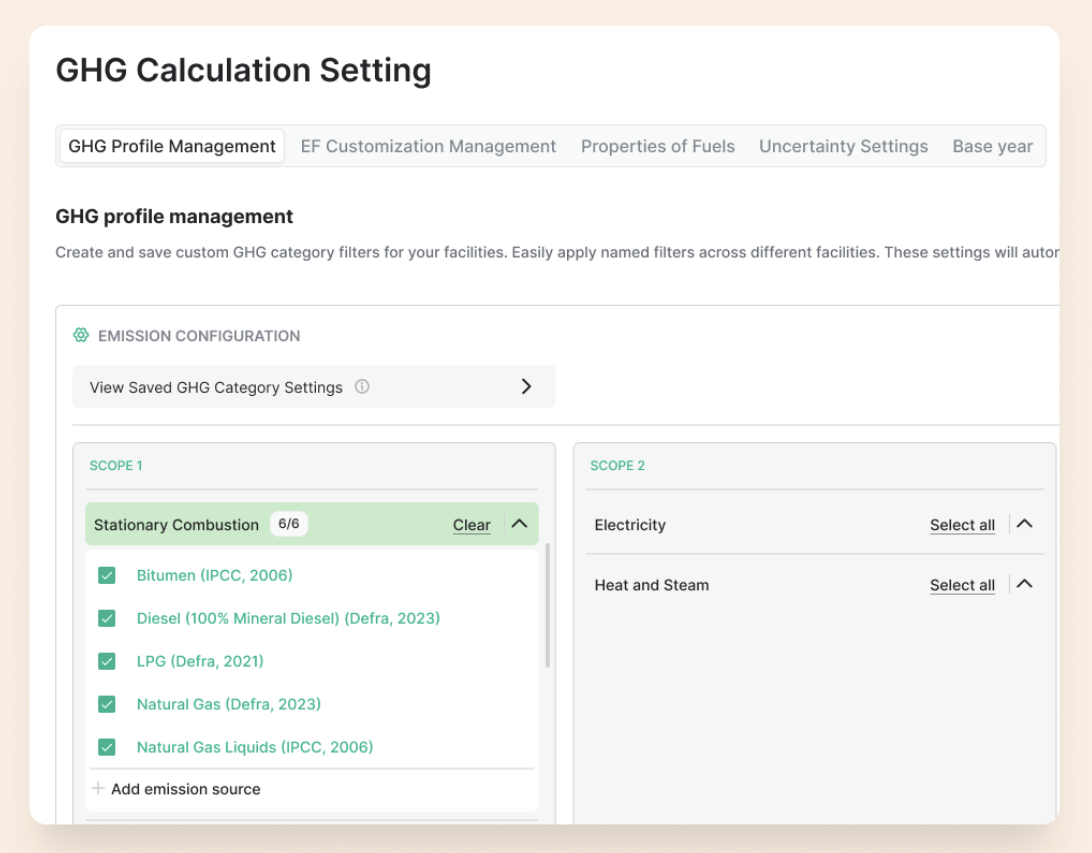
Define the parameters for precise, standards-aligned carbon accounting. With CarbonX, you have full control over every variable — from emission factors to custom GHG profiles — ensuring accuracy, transparency, and compliance in every calculation.
1. Emission Factor Library
Access a comprehensive database of over 500,000 verified emission factors to ensure precise and context-specific carbon calculations.
2. Custom Emission Factory
Define and manage your own supplier- or operation-specific emission factors to reflect your organization’s unique data and activities.
3. GHG Profile Management
Build and maintain customizable emission profiles and category filters for each facility, enabling consistent and repeatable carbon assessments.
4. Uncertainty Settings
Fine-tune uncertainty parameters to align with your data quality and reporting standards, ensuring transparency and methodological accuracy.
Data Entry Options
Bring your carbon data into CarbonX effortlessly — from a single invoice to thousands of records or full system integrations. CarbonX ensures every entry is fast, accurate, and audit-ready.

1. AI-Powered Upload
Drag and drop PDFs or invoices (electricity, natural gas, fuel, and more). CarbonX AI automatically extracts and maps all carbon-relevant data.
2. Structured Forms
Use guided, pre-defined forms with built-in validation to ensure accuracy and consistency during manual data entry.
3. Bulk Data Import
Upload large datasets via Excel or CSV, perfect for managing emissions across multiple facilities or regions.
4. Seamless Integrations
Connect billing, ERP, or accounting systems directly to CarbonX — eliminating manual input and ensuring real-time data flow.
Verification Documents
Easily upload supporting evidence required by auditors or verifiers during the emissions validation process.
Data Review Workflow
From upload to calculation, CarbonX validates and organizes your data at every stage. Monitor extraction results, review entries, and track progress with full transparency.

1. Uploaded Files
Maintain a complete audit trail of every uploaded document for traceability and efficient resolution of data gaps.
2. Extraction Review
Inspect AI-extracted activity data in a structured view to confirm accuracy and quickly identify discrepancies.
3. Quality Review & Approval
Run internal validation checks to ensure data quality, completeness, and accuracy before final calculations.
4. Data Status Tracking
Label and monitor each dataset through every phase — from upload to emission calculation — for end-to-end visibility and control.
Calculation Engine
Convert raw activity data into scoped, validated, and categorized emissions — instantly. Detect anomalies, ensure data integrity, and guarantee every calculation aligns with recognized reporting standards before moving to disclosure.

1. Automated Emission Factor Mapping
Automatically match activity data to the correct emission factors using the CarbonX Emission Factor Library for consistent and traceable results.
2. Scope Classification (GHG Protocol Aligned)
Assign each activity to Scope 1, 2, or 3 based on built-in GHG Protocol logic, ensuring full methodological compliance.
3. Anomaly Detection & Data Validation
Identify inconsistencies or outliers through automated checks against historical trends and expected performance patterns.
4. Categorized Emission Outputs
Generate detailed emissions data by facility, time period, and activity type — fully structured and ready for reporting, dashboards, or assurance reviews.
Scope 1, 2, and 3 Calculations
CarbonX delivers accurate, regulation-ready GHG assessments across all emission scopes — fast, consistent, and designed to power strategic climate action.

1. Scope 1 – Direct Emissions
Quantify direct GHG emissions from owned or controlled sources with precision, traceability, and automated validation.
2. Scope 2 – Indirect Energy Emissions
Measure emissions from purchased electricity, steam, heating, and cooling, using both location-based and market-based methodologies.
3. Scope 3 – Value Chain Emissions
Capture upstream and downstream emissions across your entire value chain for a complete, data-driven carbon footprint.
Still need help? Ask the team